It Has Taken Over the Ship Again in German
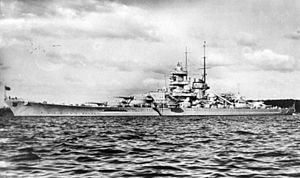 Gneisenau | |
| History | |
|---|---|
 Germany Germany | |
| Name | Gneisenau |
| Namesake | Baronial Neidhardt von Gneisenau[1] |
| Builder | Deutsche Werke |
| Laid downwards | 6 May 1935 |
| Launched | 8 December 1936 |
| Commissioned | 21 May 1938 |
| Decommissioned | 1 July 1942 |
| Fate | Sunk as a blockship 23 March 1945 and scrapped after the war. |
| General characteristics | |
| Class and type | Scharnhorst-class battleship |
| Displacement |
|
| Length | 229.8 m (753 ft eleven in) |
| Beam | 30 thou (98 ft 5 in) |
| Draft | 9.9 k (32 ft 6 in) |
| Installed power | 165,930 PS (163,660 shp; 122,040 kW) |
| Propulsion | 3 Germania geared steam turbines |
| Speed | 31 knots (57 km/h; 36 mph) |
| Range | 6,200 nmi (11,500 km; seven,100 mi) at 19 knots (35 km/h; 22 mph) |
| Complement |
|
| Armament |
|
| Armor |
|
| Shipping carried | 3 Arado Ar 196A |
| Aviation facilities | one catapult |
Gneisenau (German language pronunciation: [ˈɡnaɪ̯zənaʊ̯]) was a High german upper-case letter transport, alternatively described as a battleship and battlecruiser, of Nazi Frg's Kriegsmarine. She was the second vessel of her class, which included her sister ship, Scharnhorst. The ship was congenital at the Deutsche Werke dockyard in Kiel; she was laid down on half dozen May 1935 and launched on 8 Dec 1936. Completed in May 1938, the transport was armed with a main battery of nine 28 cm (xi in) C/34 guns in three triple turrets. Plans were approved, in one case structure had started, to replace these weapons with six 38 cm (fifteen in) SK C/34 guns in twin turrets, but as this would involve a lot of redesign, construction connected with the lower calibre guns. The intent was to brand the upgrade in the winter of 1940–41, but the outbreak of World War II stopped this.[2]
Gneisenau and Scharnhorst operated together for much of the early portion of Earth War II, including sorties into the Atlantic to raid British merchant shipping. During their first operation, the two ships sank the British auxiliary cruiser HMSRawalpindi in a short battle. Gneisenau and Scharnhorst participated in Operation Weserübung, the German invasion of Norway. During operations off Norway, the two ships engaged the battlecruiser HMSRenown and sank the aircraft carrier HMSGlorious. Gneisenau was damaged in the action with Renown and later on torpedoed by a British submarine, HMSClyde, off Norway. After a successful raid in the Atlantic in 1941, Gneisenau and her sister put in at Brest, France. The 2 battleships were the subject of repeated bombing raids by the RAF; Gneisenau was striking several times during the raids, though she was ultimately repaired.
In early 1942, the ii ships made a daylight nuance up the English Aqueduct from occupied France to Germany. After reaching Kiel in early on February, the ship went into drydock. On the nighttime of 26 February, the British launched an air attack on the ship; i bomb penetrated her armored deck and exploded in the forrard ammunition magazine, causing serious damage and many casualties. The repairs necessitated past the damage were and then fourth dimension-consuming that information technology was determined to rebuild the send to replace the nine 28 cm guns with 6 38 cm guns in double turrets. The 28 cm guns were removed and used every bit shore batteries. In 1943, Hitler ordered the cessation of conversion work, and on 27 March 1945, she was sunk as a blockship in Gotenhafen (Gdynia) in German-occupied Poland. She was eventually broken up for fleck in 1951.
Blueprint [edit]
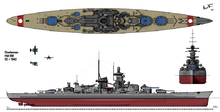
Gneisenau as she appeared in February 1942
Gneisenau displaced 32,100 long tons (32,600 t) at standard displacement and 38,100 long tons (38,700 t) at full load. She was 229.8 m (753 ft xi in) long overall and had a beam of 30 grand (98 ft v in) and a maximum draft of 9.9 m (32 ft 6 in). She was powered by 3 Germania geared steam turbines, which developed a total of 165,930 metric horsepower (163,660 shp; 122,041 kW) and yielded a maximum speed of 31.3 knots (58.0 km/h; 36.0 mph) on speed trials. Her standard crew numbered 56 officers and 1,613 enlisted men, though during the war this was augmented up to 60 officers and ane,780 men. While serving as a squadron flagship, Gneisenau carried an additional ten officers and 61 enlisted men.[3]
She was armed with a main bombardment of nine 28 cm (11.ane in) L/54.v guns arranged in three triple gun turrets: two turrets were placed forward in a superfiring system—Anton and Bruno—and one aft—Caesar. Her secondary armament consisted of twelve 15 cm (5.9 in) L/55 guns, eight of which were placed in two-gun turrets and the remaining iv were carried in private turrets. Her anti-shipping armament consisted of fourteen x.5 cm (iv.1 in) 50/65 and sixteen three.7 cm (1.v in) SK C/30 50/83, and initially ten 2 cm (0.79 in) C/xxx anti-aircraft guns. The number of 2 cm guns was eventually increased to 30-eight. Six 53.3 cm (21 in) above-water torpedo tubes, taken from the light cruisers Nürnberg and Leipzig, were installed in 1942.[3]
Gneisenau had an armor belt that was 350 mm (xiii.8 in) thick in the central portion, where it protected the transport's armament magazines and propulsion machinery spaces. The ship had an armor deck that was twenty to 40 mm (0.79 to one.57 in) thick on the flat portion, increasing to 105 mm (4.one in) on downward-sloping sides that connected to the lesser of the belt. Her main battery turrets had 360 mm (fourteen in) of armor on their faces and 200 mm (seven.9 in) on their sides. The conning tower was protected with 350 mm on the sides.[3]
Service history [edit]
Gneisenau was ordered as Ersatz Hessen as a replacement for the erstwhile pre-dreadnought Hessen, under the contract name "E."[3] The Deutsche Werke in Kiel was awarded the contract, where the keel was laid on vi May 1935.[4] The ship was launched on 8 December 1936, later which plumbing equipment-out work was begun.[5] The ship was completed in May 1938 and deputed for sea trials on the 21st,[half-dozen] nether the command of Kapitän zur Run across (KzS) Erich Förste.[vii] [6] The trials revealed a dangerous trend to send considerable amounts of h2o in heavy seas. This acquired flooding in the bow and damaged electrical systems in the frontward gun turret. As a result, she went back to the dockyard for extensive modification of the bow. The original straight stem was replaced with a raised "Atlantic bow."[viii] A diagonal cap was fitted to the smoke stack to keep the main mast free of smoke.[ix] The modifications were completed by September 1939, by which fourth dimension the ship was finally fully operational.[eight]
Gneisenau left Germany for a round of trials in the Atlantic in June 1939. Every bit it was peacetime, the send carried primarily practice armament, with only a pocket-sized number of live rounds. She was back in Germany when war began in September 1939. On the 4th, the 24-hour interval afterward the British declaration of state of war, Gneisenau was attacked by fourteen Wellington bombers, though they made no hits.[10] In November, KzS Förste was replaced by KzS Harald Netzbandt.[7] The ship's outset combat functioning, under the command of Admiral Wilhelm Marschall, began on 21 November 1939;[x] the ship, in company with her sister Scharnhorst, the light cruiser Köln, and ix destroyers, was to patrol the expanse between Iceland and the Faroe Islands. The intent of the performance was to draw out British units and ease the pressure on the heavy cruiser Admiral Graf Spee, which was being pursued in the South Atlantic. 2 days later, the German flotilla intercepted the auxiliary cruiser Rawalpindi.[11]
Scharnhorst fired first, followed past Gneisenau eight minutes later. The ship was quickly reduced to a burning wreck; Marschall ordered Scharnhorst to pick up survivors while he stood by in Gneisenau. The cruiser Newcastle arrived on the scene, which prompted Marschall to halt rescue operations and abscond. 4 allied majuscule ships, the British Hood, Nelson, Rodney, and the French Dunkerque followed in pursuit. The Germans reached Wilhelmshaven on 27 November, and on the trip both battleships incurred significant damage from heavy seas and winds.[10] Afterwards returning to Kiel, Gneisenau went into drydock for repairs for the tempest damage. During the repairs, the bow was remodeled a second time to incorporate boosted flare and sheer, in an attempt to improve her seaworthiness. Gneisenau went into the Baltic for trials on xv January 1940, after the completion of the refit. Her voyage back to the North Ocean was blocked by ice in the Kiel Canal until 4 February.[12]
Operation Weserübung [edit]

Gneisenau was assigned to the forces participating in Performance Weserübung, the invasion of Denmark and Norway. She and her sister were the covering force for the assaults on Narvik and Trondheim (Flag Officer Vize Admiral Günther Lütjens). The two ships left Wilhelmshaven on the forenoon of 7 Apr, forth with the heavy cruiser Admiral Hipper and fourteen destroyers. The cruiser and destroyers carried the assault forces for Narvik and Trondheim, while Gneisenau and Scharnhorst provided cover for them.[12] Subsequently that twenty-four hour period, at around xiv:30, the 3 ships came under attack by a force of British bombers, though the bombers failed to make any hits.[thirteen] On the morning time of 8 April, the destroyer Z11 Bernd von Arnim encountered the British destroyer Glowworm. Earlier being sunk, Glowworm rammed Admiral Hipper, though the latter was not seriously damaged. The crews of the two battleships went to battle stations, though they did not have role in the cursory engagement. At 21:00, Gneisenau and Scharnhorst took upwards a position west of the Vestfjorden to provide distant cover to both of the landings at Narvik and Trondheim.[12]
At 04:30 on the 9th, Gneisenau located the British battlecruiser Renown with her Seetakt radar; the call to battle stations rang out on both Gneisenau and Scharnhorst, though it was Renown that fired kickoff, at 05:05.[12] Gneisenau scored two hits on Renown; the first failed to explode and the second exploded on her upper deck and damaged the radio equipment. Gneisenau and Scharnhorst and then turned to disengage.[fourteen] Near simultaneously, two of Renown's 15 in (38 cm) shells struck Gneisenau. One beat striking the director tower and passed through it without exploding; regardless, it cut several cables and killed i officer and v enlisted men. The 2nd shell disabled the rear turret. This prompted Gneisenau to cease firing and increase speed in order to break away from Renown. Vice Admiral Lütjens feared that the destroyers escorting Renown could be used to make torpedo attacks confronting his unescorted battleships.[12] In the course of the action, Gneisenau fired lx 28 cm and eight 15 cm rounds. During the high-speed escape, both Gneisenau and Scharnhorst were flooded by significant quantities of water over their bows, which caused issues in both of their forrard gun turrets.[15]
Admiral Hipper rejoined the two battleships off Trondheim on the morning of 11 April, and the iii ships returned to Wilhelmshaven, arriving the following day. At that place, the damage incurred during the date with Renown was repaired. She was then drydocked in Bremerhaven for periodic maintenance on 26–29 April.[16] The transport was to become to the Baltic following the completion of repairs,[17] but on the morning of 5 May, while steaming at 22 knots (41 km/h; 25 mph) off the Elbe estuary, Gneisenau detonated a magnetic mine virtually 21 k (69 ft) off the port rear quarter and 24 m (79 ft) below the hull. The explosion acquired significant impairment to the hull and flooded several compartments, which caused the ship to take on a one-half-degree list to port. The concussive shock from the smash damaged many internal and topside components, including the starboard low-pressure level turbine and the rear rangefinders. Repairs were effected in a floating drydock in Kiel from six to 21 May. A brief shakedown cruise followed in the Baltic, and by the 27th, she was back in Kiel at full combat readiness.[16]
Gneisenau and Scharnhorst left Wilhelmshaven on 4 June to return to Kingdom of norway. They were joined by Admiral Hipper and four destroyers.[16] The purpose of the sortie (Functioning Juno) was to interrupt Centrolineal resupply efforts to the Norwegians and to relieve the pressure on German troops fighting in Norway.[eighteen] On vii June, the squadron rendezvoused with the tanker Dithmarschen to refuel Admiral Hipper and the iv destroyers.[16] The next mean solar day, they discovered and sank the trawler Juniper, along with the oil tanker Oil Pioneer.[19] The Germans then launched their Arado 196 bladder planes to search for more than Allied vessels. Admiral Hipper and the destroyers were sent to destroy Orama, a xix,500-long-ton (19,800 t; 21,800-short-ton) rider ship; the Germans allowed Atlantis, a hospital transport, to proceed unmolested. Admiral Marschall, who had returned from ill get out to control the sortie, detached Admiral Hipper and the four destroyers to refuel in Trondheim, while he steamed to the Harstad area.[16]

At 17:45, the German battleships spotted the British aircraft carrier Glorious and two escorting destroyers, Ardent and Acasta, at an approximate range of 40,000 m (44,000 yd). The German ships turned towards Glorious and increased speed from 19 knots (35 km/h; 22 mph) to 29 knots (54 km/h; 33 mph) and then turned again to intercept, still increasing in speed. Gneisenau opened burn on Agog, the nearest destroyer at 18:28. Scharnhorst, the lead ship, fired at Glorious 4 minutes afterward from a range of 26,000 m (28,000 yd). Scharnhorst achieved a hitting with her third salvo at xviii:38 and before long later on engaged Ardent with her secondary armament, whilst still firing at Glorious with the main ammunition. Ardent fired the first of several torpedoes at the two High german ships, requiring Scharnhorst to accept evasive action at xviii:45, and again x minutes later. Gneisenau opened fire on Glorious at xviii:46. A problem with Scharnhorst's boilers now reduced her speed to 29 knots (54 km/h; 33 mph), so Gneisenau took over station ahead.[20] By at present, Glorious was burning and listing heavily to starboard, but still travelling at loftier speed.[21]
The British ships made extensive use of smoke screens. Though the High german battleships had available their Seetakt radar to assist the gunlaying, lack of target visibility required temporary ceasefires due to this smoke. The Germans constitute that the British destroyers were skilfully handled, making them difficult targets. Agog continued firing torpedoes after receiving serious impairment that reduced her speed. She eventually capsized at 19:22, at which time Glorious was called-for fiercely. Acasta then headed for the German ships, making smoke and firing torpedoes. One torpedo hitting Scharnhorst at 19:39 when she returned to her course besides presently later on taking evasive action. Acasta was hit on making a second torpedo assail out of her smokescreen and severely damaged, sinking at virtually xx:08.[21]
The torpedo striking on Scharnhorst caused serious damage. After all three British ships had been sunk, Marschall withdrew his forcefulness to Trondheim to conduct emergency repairs to Scharnhorst. In the meantime, Marschall sortied with Gneisenau, Admiral Hipper, and 4 destroyers, though later on two days he returned to Trondheim when it became clear that the British convoys were besides heavily guarded.[22]
Admiral Günther Lütjens replaced Marschall as the commander of the squadron permanently, and on 20 June Lütjens sortied with Gneisenau, Admiral Hipper, and four destroyers in the direction of Republic of iceland. His intention was to give the impression he was attempting to break out into the Atlantic, to draw British attending away from Scharnhorst as she fabricated the return voyage to Germany. About 40 nmi (74 km; 46 mi) northwest of Halten, however, the submarine Clyde torpedoed Gneisenau. The torpedo hit Gneisenau in the bow, but forward of the splinter belt, and caused serious damage. The ship took on a significant corporeality of h2o in the two frontwards watertight compartments, and she was forced to render to Trondheim at reduced speed.[23] In Trondheim, the repair transport Huascaran effected temporary repairs that permitted Gneisenau to render to Kiel on 25–27 July, escorted by Admiral Hipper, Nürnberg, four destroyers, and half dozen torpedo boats. A potent forcefulness from the British Domicile Fleet attempted to intercept the flotilla, only the British failed to discover it. Upon arrival, Gneisenau went into drydock at the Howaldtswerke dockyard for 5 months of repair work.[24] In August, the ship'southward commander was replaced by KzS Otto Fein, who would captain the ship for the majority of her active wartime career.[7]
Operation Berlin [edit]
Scharnhorst joined Gneisenau, in grooming for Operation Berlin, the planned breakout into the Atlantic Bounding main designed to wreak havoc on the Centrolineal shipping lanes.[24] Severe storms caused damage to Gneisenau, though Scharnhorst was undamaged. The two ships were forced to put into port during the storm: Gneisenau went to Kiel for repairs while Scharnhorst put into Gdynia (Gotenhafen). Repairs were quickly completed, and on 22 January 1941, the two ships, again under the command of Admiral Lütjens, left port for the Due north Atlantic. They were detected in the Skagerrak and the heavy units of the British Home Fleet deployed to cover the passage between Republic of iceland and the Faroes. The Germans' radar detected the British at long range, which allowed Lütjens to avoid the British patrols, with the aid of a squall. By 3 February, the two battleships had evaded the last British cruiser patrol, and had broken into the open Atlantic.[25]

Gneisenau after her second bow alteration in 1942.
On 6 Feb, the two ships refueled from the tanker Schlettstadt southward of Cape Adieu. Before long later 08:30 on eight Feb, lookouts spotted convoy HX 106, though it was escorted by the battleship Ramillies. Lütjens' orders prohibited him from engaging Centrolineal capital ships, and so the set on was chosen off. Scharnhorst 's commander, KzS Hoffmann, nevertheless, closed to 23,000 1000 (25,000 yd) in an attempt to lure Ramillies away from the convoy so that Gneisenau could attack the convoy. Lütjens ordered Hoffmann to rejoin the flagship immediately. The two battleships steamed off to the northwest to search for more aircraft. On 22 February, the pair spotted an empty convoy sailing west, though it dispersed at the appearance of the battleships. Gneisenau sank three ships, and along with a 4th destroyed by Scharnhorst, the pair deemed for 25,784 GRT of Allied shipping.[25]
Lütjens then decided to move to a new area, as the surviving members of the dispersed convoy had sent distress signals. He chose the Cape Town-Gibraltar convoy route, and positioned himself to the northwest of Cape Verde. The two ships encountered another convoy, escorted by the battleship Malaya, on 8 March. Lütjens again forbade an attack, though he adumbral the convoy and directed U-boats to attack it. A pair of U-boats sank a total of 28,488 GRT of aircraft on the dark of seven–8 March. Malaya turned on the ii battleships and closed to 24,000 m (26,000 yd), well within the range of the Germans' guns, only Lütjens refused to be drawn into an appointment.[26] He instead turned toward the mid-Atlantic, where the two ships refueled from the tankers Uckermark and Ermland on 12 March.[27]
On fifteen March, the 2 battleships, with the two tankers in company, encountered a dispersed convoy in the mid-Atlantic. Gneisenau captured three tankers and sank a fourth, totaling twenty,139 GRT of shipping. The next day, stragglers from a convoy were sighted. Gneisenau sank seven ships for 26,693 GRT, while her sister accounted for half-dozen vessels for 35,088 long tons (35,651 t).[28] Ane of the surviving ships radioed the location of the German battleships, which summoned the powerful British battleships Rodney and Male monarch George 5. Scharnhorst and Gneisenau used their loftier speed to escape in a squall, and the intervention by the British battleships convinced Lütjens that the chances of further success were small. He therefore decided to caput for Brest in occupied France, which the ships reached on 22 March. She so entered drydock for periodic maintenance.[29]
Air attacks in Brest [edit]
After arriving in Brest, Gneisenau was the subject of repeated British air raids. The first assault took place on the dark of thirty–31 March, and a second occurred on 4–5 April. During this 2d raid, a 227 kg (500 lb) armor-piercing (AP) bomb narrowly missed the transport. As a effect of the attacks, the ship was moved out of the dry dock and moved to the harbor.[29] On six April, Gneisenau was attacked past British torpedo bombers, which managed to score a single hitting.[xxx] The Bristol Beaufort that struck the transport was piloted by Flying Officeholder Kenneth Campbell, who was killed in the attack, for which he was awarded the Victoria Cross.[31] The torpedo struck Gneisenau in the vicinity of the rear main bombardment turret. Some 3,050 t (3,000 long tons) of h2o flooded the ship and acquired a 2 degree list to starboard. The flooding besides disabled several components of the transport'south propulsion system. The explosion caused significant devastation to the side plating as well equally the starboard and centerline propeller shafts. The concussive shock too acquired widespread impairment to the transport's electronic components. A salve tug came alongside to help in the pumping try. Following the attack, Gneisenau returned to the drydock for repairs.[32]
Three days subsequently, on the night of 9–ten April, several British bombers dropped around 25 t (25 long tons) of 227 kg AP bombs on the ship, iv of which hit. All four striking the starboard side of the forward superstructure. Two of the bombs exploded on the main armor deck while the other 2 failed to detonate. The attack killed 72 initially and wounded 90, of whom xvi later died of their injuries. The bombs slightly damaged the main armor deck and caused some structural damage on the starboard side. It was decided to make alterations to the ship while she was drydocked for repairs; these included the installation of xiv additional 2 cm anti-aircraft guns and six 53.3 cm torpedo tubes amidships. The aircraft hangar was rearranged, and the catapult that had been mounted on top of it was removed. The length of repairs and modifications precluded participation in Operation Rheinübung, the sortie past the new battleship Bismarck in May 1941. The British continued to set on the ship in drydock, though no further damage was done.[33] On half dozen Feb 1942, a bomb fell close to Gneisenau, but acquired no damage.[34]
Operation Cerberus [edit]
On 12 January 1942, the German Naval Control, in a conference with Hitler, fabricated the decision to return Gneisenau, Scharnhorst, and the heavy cruiser Prinz Eugen to Federal republic of germany. The intention was to deploy the vessels to Norway to interdict Centrolineal convoys to the Soviet Union. The and then-called "Channel Nuance", codenamed Operation Cerberus, would avert the increasingly effective Allied radar and patrol shipping in the Atlantic. Vice Admiral Otto Ciliax was given control of the functioning. In early February, minesweepers swept a route through the English Channel, though the British failed to detect the activeness.[35]

At 23:00 on xi February, Scharnhorst, Gneisenau, and Prinz Eugen left Brest. They entered the Channel an 60 minutes later on; the iii ships sped at 27 knots (50 km/h; 31 mph), hugging the French declension forth the voyage.[35] The British failed to detect their divergence, every bit the submarine that had been tasked with observing the port had withdrawn to recharge its batteries.[36] By 06:thirty, they had passed Cherbourg, at which point they were joined by a flotilla of torpedo boats.[35] The torpedo boats were led by Kapitän Erich Bey, aboard the destroyer Z29. General der Jagdflieger (Full general of Fighter Strength) Adolf Galland directed Luftwaffe fighter and bomber forces (Operation Donnerkeil) during Cerberus.[37] The fighters flew at masthead-height to avoid detection by the British radar network. Liaison officers were present on all three ships. High german aircraft arrived later to jam British radar with crust.[35] Past 13:00, the ships had cleared the Strait of Dover, though one-half an 60 minutes later, a flight of six Swordfish torpedo bombers, with Spitfire escort, attacked the Germans. The British failed to penetrate the Luftwaffe fighter shield and all six Swordfish were destroyed.[38] [39] Several more than attacks were launched over the next 2 hours, but the Luftwaffe screen repulsed them all.[40]
Five British destroyers mounted an attack on the German squadron at 16:17. The ships attempted to shut to torpedo range, though heavy seas and overcast atmospheric condition hampered their set on. Gneisenau and Prinz Eugen inflicted serious damage to the destroyer Worcester.[41] At 19:55, Gneisenau detonated a magnetic mine off Terschelling. The mine exploded just forward of the rear gun turret but acquired only modest harm. Slight flooding was chop-chop stopped, though the daze disabled the center turbine. The transport stopped for less than 30 minutes earlier resuming the voyage; by 03:50, Gneisenau and two destroyers reached Helgoland. After existence joined in that location by Prinz Eugen, the ships left for Kiel, simply thick ice in the canal forced the ships to terminate in Brunsbüttel. While maneuvering in port, Gneisenau struck a submerged wreck. The standoff tore a pigsty in the hull and acquired some small flooding.[42] Gneisenau reached Kiel the following day, where she went into a floating dry dock at the Deutsche Werke dockyard.[34]
Fate [edit]

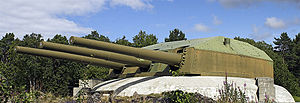
Top:Aeriform reconnaissance photograph of Gneisenau in dry out dock, March 1942, after the air attack. Bottom: Gneisenau 's 28 cm turret Caesar at Austrått Fort, Kingdom of norway.
Repair piece of work on Gneisenau was completed by 26 February 1942, and she was scheduled to deploy to Norway on 6 March. Despite the fact that she was however in dry dock, her ammunition stores had been restocked and she was prepared for a short round of trials before her deviation. On the nighttime of 26–27 February, however, the British launched a heavy air raid on the send.[43] The ship was hitting by a single bomb in her forecastle that penetrated the armored deck and exploded.[44] Red-hot bomb fragments ignited propellant charges in the forrad turret and caused a tremendous explosion. The turret was thrown off its mount and the entire bow department was burned out.[34] The crew partially flooded the mag to forestall a more catastrophic explosion. The blast killed 112 men and wounded 21 others.[45]
The extensive harm convinced the Naval Staff to rebuild Gneisenau to mount the six 38 cm guns originally planned, rather than repair the ship. The damaged bow section was removed in order to attach a lengthened bow, which would correct the decrease in freeboard that would have been acquired by the heavier 38 cm guns.[46] On 4 April, the ship went to Gotenhafen, escorted by the training ship Schlesien and the icebreaker Brush.[34] She was formally decommissioned on i July.[44] Her coiffure were paid off and redeployed to the U-gunkhole arm.[47]
By early 1943, the transport had been sufficiently repaired to begin the conversion procedure, just Hitler, angered by the failure of German surface raiders at the Boxing of the Barents Body of water in Dec 1942 ordered the cessation of all work.[48] Gneisenau was disarmed and her 28 cm and 15 cm gun turrets were used in shore batteries.[44] Turret Caesar was installed in Austrått Fort near Trondheim as the littoral battery Orlandet.[6]
Gneisenau remained unused in Gotenhafen until the stop of the war. Every bit the Cherry Regular army advanced on the metropolis, the remaining crew took the ship out to the entrance of the harbor and sank the vessel as a blockship on 27 March 1945. In 1947, the Smoothen government ordered the send exist removed, and initial relieve operations began.[48] [6] The ship was sealed and refloated on 12 September 1951 then completely scrapped,[34] though it is believed that some of her steel was used in the construction of Polish merchant vessels,[49] with her horn being installed on the Dar Pomorza. The send'southward bell was preserved and it is now in the collection of the Museum of the Polish Army in Warsaw (Poland), information technology is occasionally presented at exhibitions. She was the largest ship raised at the fourth dimension. Norway offered to return the turret from Trondheim in 1979, though the offer was declined.[vi] The gun turret was instead preserved as a museum in Norway.[44]
Notes [edit]
- ^ Schmalenbach, p. 221.
- ^ Garzke & Dulin, p. 178.
- ^ a b c d Gröner, p. 31.
- ^ Campbell, p. 43.
- ^ Williamson, pp. xiv–xv.
- ^ a b c d e Gröner, p. 32.
- ^ a b c Williamson, p. 19.
- ^ a b Williamson, p. 15.
- ^ Breyer, p. xv.
- ^ a b c Garzke & Dulin, p. 134.
- ^ Williamson, pp. 8–9.
- ^ a b c d due east Garzke & Dulin, p. 135.
- ^ Williamson, p. 9.
- ^ Konstam, p. 39.
- ^ Garzke & Dulin, p. 136.
- ^ a b c d eastward Garzke & Dulin, p. 137.
- ^ Williamson, p. 16.
- ^ Williamson, p. 10.
- ^ Rohwer, p. 26.
- ^ Howland.
- ^ a b Koop & Schmolke, p. 103-110.
- ^ Garzke & Dulin, pp. 137–138.
- ^ Garzke & Dulin, pp. 138–139.
- ^ a b Garzke & Dulin, p. 139.
- ^ a b Garzke & Dulin, p. 140.
- ^ Garzke & Dulin, pp. 140–142.
- ^ Garzke & Dulin, p. 142.
- ^ Garzke & Dulin, pp. 142–143.
- ^ a b Garzke & Dulin, p. 143.
- ^ Breyer, p. 30.
- ^ Ashworth, p. 33.
- ^ Garzke & Dulin, pp. 143–144.
- ^ Garzke & Dulin, pp. 144–145.
- ^ a b c d e Breyer, p. 34.
- ^ a b c d Garzke & Dulin, p. 146.
- ^ Williamson, pp. eleven–12.
- ^ Hooton, pp. 114–115.
- ^ Hooton, p. 114.
- ^ Weal, p. 17.
- ^ Garzke & Dulin, p. 147.
- ^ Garzke & Dulin, pp. 147–148.
- ^ Garzke & Dulin, pp. 148–149.
- ^ Garzke & Dulin, pp. 149–150.
- ^ a b c d Williamson, p. 18.
- ^ Garzke & Dulin, p. 150.
- ^ Garzke & Dulin, pp. 150–151.
- ^ Garrett, p. 120, 122.
- ^ a b Garzke & Dulin, p. 153.
- ^ Garrett, p. 121.
References [edit]
- Chris, Ashworth (1992). RAF Coastal Control: 1936–1969. London: Patrick Stephens Ltd. ISBNone-85260-345-3.
- Breyer, Siegfried (1990). The German Battleship Gneisenau. West Chester: Schiffer Publishing. ISBN978-0-88740-290-6.
- Campbell, John (1987). "Federal republic of germany 1906–1922". In Sturton, Ian (ed.). Conway's All the World'south Battleships: 1906 to the Nowadays. London: Conway Maritime Press. pp. 28–49. ISBN978-0-85177-448-0.
- Garzke, William H.; Dulin, Robert O. (1985). Battleships: Axis and Neutral Battleships in World War II. Annapolis: Naval Found Press. ISBN978-0-87021-101-0.
- Garrett, Richard (1978). Scharnhorst and Gneisenau: The Elusive Sisters. London: Hippocrene Books. ISBN0-7153-7628-4.
- Gröner, Erich (1990). German Warships: 1815–1945. Vol. I: Major Surface Vessels. Annapolis: Naval Institute Press. ISBN978-0-87021-790-6.
- Hooton, Due east. R. (1997). Eagle in Flames: The Fall of the Luftwaffe. London: Brockhampton. ISBN978-1-86019-995-0.
- Howland, Vernon W., Captain, RCN (1994). "The Loss of HMS Glorious: An Analysis of the Activeness". Warship International. Toledo: International Naval Research Organisation. XXXI (1): 47–62. Archived from the original on 20 November 2007. Retrieved 25 January 2011.
- Konstam, Angus (2003). British Battlecruisers: 1939–1945. Oxford: Osprey Books. ISBN978-1-84176-633-1.
- Koop, Gerhard; Schmolke, Klaus-Peter (1991). Battleships of the Scharnhorst Course. Barnsley: Seaforth Publishing. ISBN978-1-84832-192-2.
- Rohwer, Jürgen (2005). Chronology of the War at Sea, 1939–1945: The Naval History of World War Ii. Annapolis: United states of america Naval Institute Press. ISBN978-one-59114-119-8.
- Schmalenbach, Paul (1973). "German language Battlecruisers Scharnhorst and Gneisenau". Warship Profile 33. Windsor: Profile Pubs. pp. 201–224. OCLC 20229353.
- Weal, John (1996). Focke-Wulf Fw 190 Aces of the Western Forepart. Oxford: Osprey Books. ISBN978-1-85532-595-1.
- Williamson, Gordon (2003). German Battleships 1939–45. Oxford: Osprey Publishing. ISBN978-ane-84176-498-6.
External links [edit]
- "Schlachtschiff in Fahrt". youtube.com.
Source: https://en.wikipedia.org/wiki/German_battleship_Gneisenau
0 Response to "It Has Taken Over the Ship Again in German"
Post a Comment